The Leaf Frog Life
Cycle
Below are pictures taken of our own Red Eyed Tree Frogs, the cycle begins
with breeding, and continues with the development of the eggs, the development
of the tadpoles and metamorphosis into froglets.
The Frogs are placed in a rain chamber, this is simply an aquarium with
plants and a layer of water in the bottom. At night water is pumped
through a filter and falls back into the aquarium through a perforated Plexiglas
plate, the effect is the water falling like rain. This is
to simulate their natural environment at the time of the rainy season. In
nature, the males congregate at areas which have collected rainwater, the males
will start to call at night, this serves to call over the females to the
temporary pools of water. The females generally show up after the males
have been calling for a few days. Upon arrival the males will jump onto
their backs and stay there until the female is ready to breed. As the rain
falls more often and the pools begin to fill up with water, the females descend out of the canopy down toward the water
carrying along the males attached to
their backs. They will then go down into the water and fill their bladders
with water. This water will be used to hydrate the eggs as they are
laid. The female can lay several clutches of eggs in a night, but
generally will only breed one night of a breeding season. She will
pick the location and the male will fertilize the eggs as they are laid.
The eggs will be laid on a leaf located above the temporary pool. The eggs
stick like glue to the leaf until the tadpoles hatch.
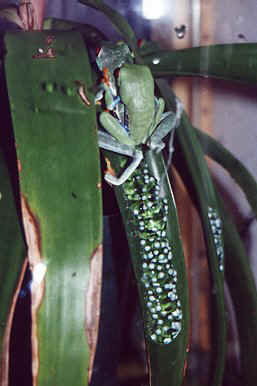 Day
0 - After a few nights of calling by the males, and riding around on the females
backs, the female will pick a leaf and start to lay her eggs. We have
found that they do this very early in the twilight hours of morning.
Our own frogs lay one to three clutches of eggs in a night, but usually the
total number laid is consistent at around 100 eggs per frog. The female
pictured on the left laid a single clutch of around 100 eggs.
Day
0 - After a few nights of calling by the males, and riding around on the females
backs, the female will pick a leaf and start to lay her eggs. We have
found that they do this very early in the twilight hours of morning.
Our own frogs lay one to three clutches of eggs in a night, but usually the
total number laid is consistent at around 100 eggs per frog. The female
pictured on the left laid a single clutch of around 100 eggs.
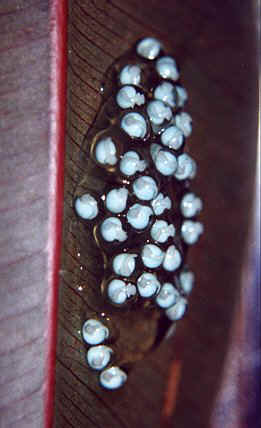 Day
2 - The eggs develop quite quickly, 2 days after they are laid the embryos are
very obvious. The eggs and embryos at this stage are a bright green to
blue-green in colour.
Day
2 - The eggs develop quite quickly, 2 days after they are laid the embryos are
very obvious. The eggs and embryos at this stage are a bright green to
blue-green in colour.
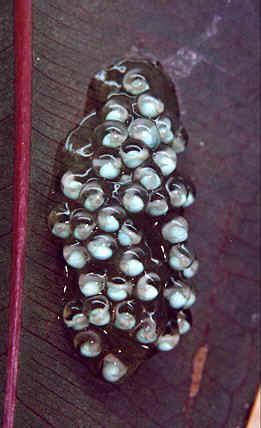 Day
3 - By day three the embryos are starting to turn colour and some of their
external morphology can be seen more clearly, like their gills, eyes head.
Day
3 - By day three the embryos are starting to turn colour and some of their
external morphology can be seen more clearly, like their gills, eyes head.
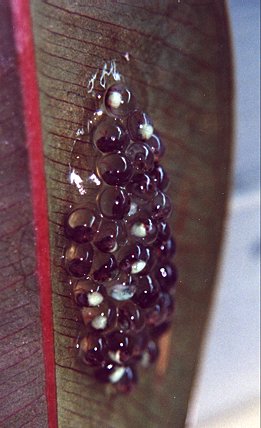 Day
5 - By day 5 the tadpoles are just about ready to hatch. Generally Red
Eyed Tree Frog tadpoles will hatch out between 5 and 7 days. The yolk sac
is almost invisible now and the tadpole has a uniform dark brown colour.
Some tadpoles (like the American Toad (Bufo americanus) hatch out of
their eggs in an underdeveloped state, they are unable to swim or move much so
they anchor themselves to a leaf or rock. Red Eyes on the other hand
develop very quickly and hatch out fully able to swim about and feed. In
fact if they feel threatened, they will even hatch out early to avoid predation
by snakes etc..
Day
5 - By day 5 the tadpoles are just about ready to hatch. Generally Red
Eyed Tree Frog tadpoles will hatch out between 5 and 7 days. The yolk sac
is almost invisible now and the tadpole has a uniform dark brown colour.
Some tadpoles (like the American Toad (Bufo americanus) hatch out of
their eggs in an underdeveloped state, they are unable to swim or move much so
they anchor themselves to a leaf or rock. Red Eyes on the other hand
develop very quickly and hatch out fully able to swim about and feed. In
fact if they feel threatened, they will even hatch out early to avoid predation
by snakes etc..
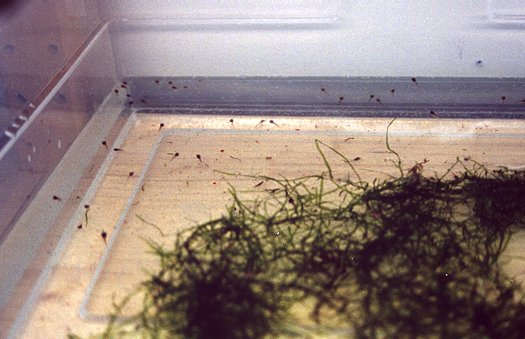
Day 6 - The tadpoles have hatched out of their eggs. Generally the
entire clutch will hatch out the same day. For the first couple of days
they are quite inactive as they use up the remains of their yolk sac contents,
but as soon as they get hungry they will start their quest for food. Red
Eyed Tree Frog tadpoles are filter feeders, they eat tiny pieces of food and
algae suspended in the water, because of this they need to be fed a food
which has been finely ground.
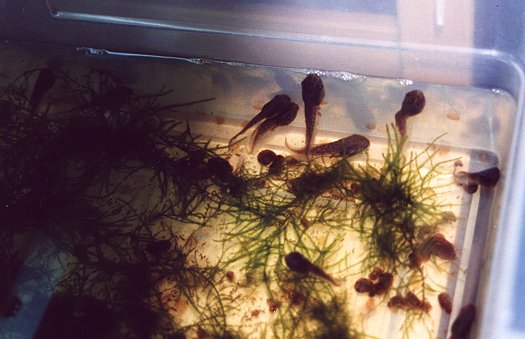
Approximately day 60 - You can
control the rate at which the tadpoles grow and how long they will stay in the
water. The warmer the water is the faster the tadpoles will grow and the
sooner they will undergo metamorphosis. The higher the number of tadpoles
in a container the faster they will morph out. Tadpoles are able to
inhibit the tadpoles around them. So as the concentration of tadpoles
increases in a pool of water, some will morph out and leave the water,
this could be an advantage to them for they would be the first to exploit the
food resources surrounding the pool, however they will usually be smaller than
the tadpoles who morph out later in the season. So those which stay in the
water longer may have less available resources but they will be larger and
stronger, and better able to deal with their surroundings. This can be used to
your advantage in raising tadpoles. We allow all of our newly hatched
tadpoles to occupy a single container (an 18" x 24" Tupperware
container). As they grow, we separate then out into two containers.
By the time the tadpoles are ready to morph out there are less than 25 tadpoles
per container. The advantage of this? You get much larger, stronger
froglets which are able to eat larger prey and are able to deal with the very
stressful stage of metamorphosis better. Above are tadpoles which are
still about a month away from metamorphosis, if you look closely, you can
see the back legs developing on one of them. Within our containers we have
Java Moss to help keep the water clean and oxygenated, and snails to clean up
uneaten food. There are no filters in our containers, this is unnecessary,
if there is a large enough surface area to water volume ratio and you do not
overload your container with too many tadpoles and excess food, oxygenation
should not be an issue. With weekly 25% water changes the build up of
wastes will not be an issue, and these frogs naturally breed in shallow
temporary pools with no water movement, so it is actually a more natural setting
for the tadpoles.
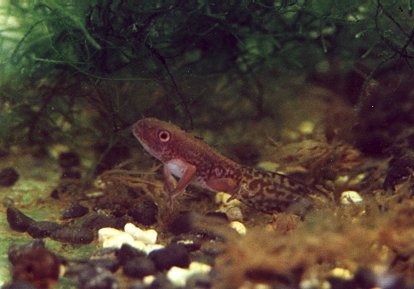 A
tadpole completing metamorphosis, once the front legs are pushed out the tadpole
will usually leave the water within 12 to 24 hours. They leave the water
with a very conspicuous tail, but they do not feed or move around much until
this tail has been absorbed.
A
tadpole completing metamorphosis, once the front legs are pushed out the tadpole
will usually leave the water within 12 to 24 hours. They leave the water
with a very conspicuous tail, but they do not feed or move around much until
this tail has been absorbed.
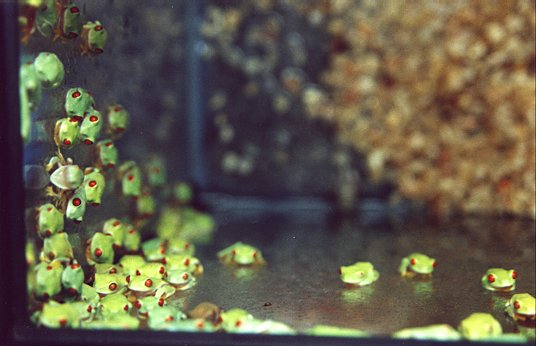
Young froglets - A group of new metamorphs just waking up to go about their
routine of nightly feeding and exploring.
Back to Leaf Frog Page
Back to Frogs Page
Home